Datos personales
lunes, 11 de junio de 2012
Production Journal 2
The second class Manuel brought the script done and sent it us by mail so we can read it and give him our opinion. After we read it, we realized that the script had lots of grammar mistakes so Honorio responsibilized of correcting it and send it it by mail.

jueves, 29 de marzo de 2012
Bollywood Musical
Bollywood films are mostly musicals, and are expected to contain catchy music in the form of song-and-dance numbers woven into the script. A film's success often depends on the quality of such musical numbers. Indeed, a film's music is often released before the movie itself and helps increase the audience.
Indian audiences expect full value for their money, with a good entertainer generally referred to as paisa vasool, (literally, "money's worth"). Songs and dances, love triangles, comedy and dare-devil thrills are all mixed up in a three-hour-long extravaganza with an intermission. Such movies are called masala films, after the Hindi word for a spice mixture. Like masalas, these movies are a mixture of many things such as action, comedy, romance and so on. Most films have heroes who are able to fight off villains all by themselves.

Melodrama and romance are common ingredients to Bollywood films. Pictured Achhut Kanya (1936)
Bollywood plots have tended to be melodramatic. They frequently employ formulaic ingredients such as star-crossed lovers and angry parents, love triangles, family ties, sacrifice, corrupt politicians, kidnappers, conniving villains, courtesans with hearts of gold, long-lost relatives and siblings separated by fate, dramatic reversals of fortune, and convenient coincidences.
There have always been Indian films with more artistic aims and more sophisticated stories, both inside and outside the Bollywood tradition (see Parallel Cinema). They often lost out at the box office to movies with more mass appeal. Bollywood conventions are changing, however. A large Indian diaspora in English speaking countries, and increased Western influence at home, have nudged Bollywood films closer to Hollywood models.
lunes, 19 de marzo de 2012
Film Pitch
Film Title: “Black Friday”
Writer: Manuel Denegri
Logline: The story of a boy that he has bad luck the whole day.
Intended audience demographic: Fourteen year-old people.
Suggested time slot: The whole day (morning, daytime, late night, etc.)
Episode length: Maximum of 5 minutes.
Genre: Black comedy.
What are we going to do: A short film of 5 minutes about a boy that wakes up one day of school and he has all the day bad luck (we are going to film all the bad experiences that he suffers that day) and when night he wakes up and realize it’s a dream so he looks to the clock and he was being late to school so he stands up and all the things that happened in the dream will really happen.
Where are we going to film: In St. George’s College and Honorio’s house.
Why are we doing this film: For an IB project of Film Studies.
What do we need: All the necessary things for making the film, for example cameras, lights, software and computer for edit.
lunes, 5 de marzo de 2012
Production Journal 1
The first class we divided into groups until we get into a group of 3 (Manuel Denegri, Honorio Oleksuk and me, Giuliana Brun).
Then we organized the rolls of each of us: Manuel is the writer and director, Honorio is the editor, and I'm the camarographer.
We started discussing the genre of our clip and we decided horror-drama.
The problem we had to afford was the theme of the clip. First we decided to do a kidnap of a rich girl but Honorio didn't like it, so then he proposed an idea of a murder of a boy after a soccer match but me and Manuel didn't like it and we continued thinking until Manuel had an idea about doing the film about a boy that has bad luck a day since he wakes up until he goes to sleep.
viernes, 21 de octubre de 2011
Brad Pitt vs Marlboro Man
Brad Pitt has actually 2 children and he is too close to them, he love them and carry of them a lot. This can be represented in:


He spend his time playing in a park with his children and enjoying all the time with them. He makes sure that every morning his children have fresh fruit for the breakfast, what represents that he wants a good and healthy life for them.
In Se7en we can see this personality of family lifestyle and nice with his wife and his dogs (can be represented like "children"). Differing to him we have Somerset that he is more cold, he don't have family neither wife and he has guns and other police stuff what represent the traditional masculinity.
In Se7en we can see this personality of family lifestyle and nice with his wife and his dogs (can be represented like "children"). Differing to him we have Somerset that he is more cold, he don't have family neither wife and he has guns and other police stuff what represent the traditional masculinity.
By the other hand we have the Marlboro Man: a traditional masculine stereotype, who has strength, courage, virility, the triumph, competition, security, and he don't shows affection. For example:
This image represents, in terms of publicity, that Marlboro is for strong man that is very masculine as he is a cowboy that is pulling out the fence, so it makes the audience believe that if they smoke Marlboro they are very masculine.
lunes, 17 de octubre de 2011
Seven - Working towards A Textual Analysis
Characters representation: Contrast between Freeman and Mills - young and old. This is shown at the end with Mill fall.
1. Genre:
- Thriller
- Mystery
- Horror
- Cop Drama
It can be said that Se7en is a crime genre because it's about all the murders that a serial killer does and the detectives and policemen chase him.
On the other hand, it's also a thriller film that contains horror and neo-noir elements because, for example, there is always lack of lighting, shadows and some grey and dark lights, adding to it the rain that it's always present, creates a feeling of coldness. Also in the setting, for example, that there is always laberints and other places in which the audience can feel the enclosing and presure that the character is suffering - clausytophobic (element of setting are conventional in thriller and horror). The film has always diagetic sounds and background music that creates suspense and tense.
Mystery, because the film plays a game with the audience - there are twists and turns before we find out the truth plot.
Finally, the cop drama because the stock characters old and young partners put together.
1. Genre:
- Thriller
- Mystery
- Horror
- Cop Drama
It can be said that Se7en is a crime genre because it's about all the murders that a serial killer does and the detectives and policemen chase him.
On the other hand, it's also a thriller film that contains horror and neo-noir elements because, for example, there is always lack of lighting, shadows and some grey and dark lights, adding to it the rain that it's always present, creates a feeling of coldness. Also in the setting, for example, that there is always laberints and other places in which the audience can feel the enclosing and presure that the character is suffering - clausytophobic (element of setting are conventional in thriller and horror). The film has always diagetic sounds and background music that creates suspense and tense.
Mystery, because the film plays a game with the audience - there are twists and turns before we find out the truth plot.
Finally, the cop drama because the stock characters old and young partners put together.
lunes, 3 de octubre de 2011
Noir Conventions in Seven
Elements of Film Noir:
Setting: Decayed, unknown and dirty city in which it's always raining.
Angles: There is a distortion of angles, close-ups, dutch angles
Sound: Diagetic street scream, noises and rain all the time. It creates the audience emphathy.
Characters: Two ditective (irresponsable, uninterested officers that don't care about their work), seven victims and their family.
Lighting: Heavy use of shades and low lighting. Only natural ambient light (no artificial light) except the flashlights and television.
Colours: Blue-ish grey in the Police station, forensics laboratory. Suggests the technological environment, but also cold and unfeeling world of the film.
Sound 2: Non-diagetic: music, heavy use of low key chords, violing low.
Inclusion of gore, crudety

 close-up
Setting: Decayed, unknown and dirty city in which it's always raining.
Angles: There is a distortion of angles, close-ups, dutch angles
Sound: Diagetic street scream, noises and rain all the time. It creates the audience emphathy.
Characters: Two ditective (irresponsable, uninterested officers that don't care about their work), seven victims and their family.
Lighting: Heavy use of shades and low lighting. Only natural ambient light (no artificial light) except the flashlights and television.
Colours: Blue-ish grey in the Police station, forensics laboratory. Suggests the technological environment, but also cold and unfeeling world of the film.
Sound 2: Non-diagetic: music, heavy use of low key chords, violing low.
Inclusion of gore, crudety

miércoles, 28 de septiembre de 2011
Pulp Fiction - Textual Analysis
Pulp Fiction is a 1994 American crime and gangster film directed by Quentin Tarantino.
In the drug scene the plot is about drugs and piercings in which Jody, Fabienne and Vincent are having a strange, alternative and rebellious dialogue about piercings related with sex and provocation (sexual pleasure) while Lance is preparing the different drugs for selling it to Vincent.
Vega is a drug dependent and in this scene he has lots of close-ups and the camera follows him.
It can be said that the three caracters that were in the house (except for Vincent) don't fit in the society as Jody has 18 piercings and Lance is a drug dealer, what is not common.
In this scene there are some still shots in which there are many close-ups in faces (when talking about piercings and when Vincent is in the car injecting himself drugs) and in the drugs on the bed. There are also extreme-close ups in the syringe and the preparation of drugs; low shot showing the reflection in the mirror of Vincent and Lance (bedroom of drug dealer);medium-close up in Vincent when he is counting his money sitting in a chair with "hippie" stuff arround him.
The scene creates a feeling of being "flying away" because of the effects of the drugs by the provocative background music (dream-like guitars); there is lack of lighting, with shadows (Vincent in his car - "dark world" because of drugs), highliting with close-ups and light in the drugs and it's preparation, and there are dark colours, white and red; slow motions when Vincent is riding the car, "drugs effect" creating a feeling of "drug tentation" , there is also slow movement when he is inyecting himself; close-ups in faces and drugs (preparations, inyections, etc.); dutch angle shots and alternative when the boys are talking about the different characteristics of the drugs and the camera is in a low angle showing the bed, Vincent, half part of Lance and the other half reflected in the mirror.
In my opinion, Tarantino tries to persuade the audience to consume drugs and that they are good because it shows in the whole movie the relaxing and pleasure effects that the drugs create
In the drug scene the plot is about drugs and piercings in which Jody, Fabienne and Vincent are having a strange, alternative and rebellious dialogue about piercings related with sex and provocation (sexual pleasure) while Lance is preparing the different drugs for selling it to Vincent.
Vega is a drug dependent and in this scene he has lots of close-ups and the camera follows him.
It can be said that the three caracters that were in the house (except for Vincent) don't fit in the society as Jody has 18 piercings and Lance is a drug dealer, what is not common.
In this scene there are some still shots in which there are many close-ups in faces (when talking about piercings and when Vincent is in the car injecting himself drugs) and in the drugs on the bed. There are also extreme-close ups in the syringe and the preparation of drugs; low shot showing the reflection in the mirror of Vincent and Lance (bedroom of drug dealer);medium-close up in Vincent when he is counting his money sitting in a chair with "hippie" stuff arround him.
The scene creates a feeling of being "flying away" because of the effects of the drugs by the provocative background music (dream-like guitars); there is lack of lighting, with shadows (Vincent in his car - "dark world" because of drugs), highliting with close-ups and light in the drugs and it's preparation, and there are dark colours, white and red; slow motions when Vincent is riding the car, "drugs effect" creating a feeling of "drug tentation" , there is also slow movement when he is inyecting himself; close-ups in faces and drugs (preparations, inyections, etc.); dutch angle shots and alternative when the boys are talking about the different characteristics of the drugs and the camera is in a low angle showing the bed, Vincent, half part of Lance and the other half reflected in the mirror.
In my opinion, Tarantino tries to persuade the audience to consume drugs and that they are good because it shows in the whole movie the relaxing and pleasure effects that the drugs create
lunes, 12 de septiembre de 2011
Pulp Fiction - Textual Analysis (NOTES)
- narrative: plot about drugs and piercings (talking about sex and provocation)
- genre: crime and gangster
- presentation of characters: Jody and the other woman talking about piercings, Vincent and drug dealer (Lance) talking about the different types of drug. Outcast characters (dont fit in society): 18 piercings, drug delears, etc.
- camera angles, shots and movement: still shots: close-ups in faces (when talking about piercings and when Vincent is in the car), the drugs on the bed; extreme-close up in the syringe and the preparation of the drugs; low shot showing the reflection in the mirror of Vincent and Lance(bedroom of drug dealer); medium-close up in Vincent when he is counting his money sitting in a chair with "hippie" stuff arround him.
- editing and sequencing: slow motion when Vincent is riding the car "drugs effect" creating a feeling of "drug tentation"
- lighting, shade and colour: shadows (Vincent in car - "dark world" because of drugs) lack of lighting.
- sound: provocative background music
- location and set design: Lance's house (hippie decoration), Vicent's car.
- genre conventions:
- target audience of the film :
"Crime stories in this genre often highlight the life of a crime figure or a crime's victim(s)."
"Gangster/crime films are usually set in large, crowded cities, to provide a view of the secret world of the criminal: dark nightclubs or streets with lurid neon signs, fast cars, piles of cash, sleazy bars, contraband, seedy living quarters or rooming houses."
lunes, 5 de septiembre de 2011
Production Journal 4
Two weeks before the classes re-started, our teacher gave us a day (tuesday) in which we could miss school for finish filming.
At 10 am we met on Viveka's house and took all our memory cards that we had. There we put all our camera batteries and celphones to charge (so there is no problem), we searched the adresses of different tattoo shops for going and we had breakfast.
Then we took all our cameras, celphones, memory cards, tripod, money, etc. and walked again to the Bond Street.
There we interview 2 different tattooers and also one man that was tattooing her girlfriend's name in his arm.
Then we went to Mc Donald's to have lunch and then we continued filming another tattooer.
We recovered a lot of footish, including photographs.
At 10 am we met on Viveka's house and took all our memory cards that we had. There we put all our camera batteries and celphones to charge (so there is no problem), we searched the adresses of different tattoo shops for going and we had breakfast.
Then we took all our cameras, celphones, memory cards, tripod, money, etc. and walked again to the Bond Street.
There we interview 2 different tattooers and also one man that was tattooing her girlfriend's name in his arm.
Then we went to Mc Donald's to have lunch and then we continued filming another tattooer.
We recovered a lot of footish, including photographs.
domingo, 4 de septiembre de 2011
PRODUCTION JOURNALS - becoming more analytical
Watch the student film, "Treehouse". Initial comments as to its strengths/weaknesses?
Plot not interesting, good use of music, bad lighting, good actors, good shots and sound.
Read the commentary extract from the director's production journal. To what extent does it meet the guidelines above?
Good shot positions (close-ups, medium close-ups, etc.), good colour in the images but bad lighting when interviewing the others in close places, good use of storyboard, good editing in jump cuts and putting three shots of interviews together in one shot, good and clear sound, music well used, good costumers, backgrounds related with the characters.
Plot not interesting, good use of music, bad lighting, good actors, good shots and sound.
Read the commentary extract from the director's production journal. To what extent does it meet the guidelines above?
Good shot positions (close-ups, medium close-ups, etc.), good colour in the images but bad lighting when interviewing the others in close places, good use of storyboard, good editing in jump cuts and putting three shots of interviews together in one shot, good and clear sound, music well used, good costumers, backgrounds related with the characters.
lunes, 15 de agosto de 2011
Production Journal 2
For searching about the tattoos we went one saturday to the "Bond Street" in Capital and went to different tattoo shops. There, we talked to the people encharged of the shops and ask them for permition for filming them and do our documental about them and they were fine. They gave us their cards with all their information so we tried to contacted them by phone in the Film class but they didn't answer so we tried by mail and told them about what day we were going to go. When they answered our mail, we agreed to go the next thursday after school (before the winter holidays start) to a tattoo shop called Tattoo Ink because we considered the most serious place and people for work with them. Also it's a very good setting for filming as it has a lot of space for us to be confortable with all the materials without disturbing and it has a great background with a rocker style.
lunes, 8 de agosto de 2011
Production Journal 3
Sabrina went to Viveka's house in Capital and I went to mines in Capital too. At 5.30 pm we met in the Bond Street for starting to film. There I filmed the walls of the corridors of the Bond Street that has lots of graffities for make it the opening of the documentary, so then Sabrina edits those images in fast shots and adds rock music.
When we arrived to the shop, Viveka talked with the owners of the tattoo shop for being sure that everything is alright and answer any question or doubt they would have; Sabrina told them what they have to talk about and the theme of our documentary; and I, as the camera-woman, decided what is the best angle for filming, where the light reflects better, where the sound it's going to be clearer, etc.
Luckily, there was a customer that was doing a tattoo, so we took advantage of the situation and Viveka asked him and the tattooer if I could film them a little bit, and they agreed.
After filming 20 min, more or less, I realized the camera run out of memory, so we had to stop filming and go to our houses, downlaod the footish we had to our laptops for having much space for continuing filming an other day.
When we arrived to the shop, Viveka talked with the owners of the tattoo shop for being sure that everything is alright and answer any question or doubt they would have; Sabrina told them what they have to talk about and the theme of our documentary; and I, as the camera-woman, decided what is the best angle for filming, where the light reflects better, where the sound it's going to be clearer, etc.
Luckily, there was a customer that was doing a tattoo, so we took advantage of the situation and Viveka asked him and the tattooer if I could film them a little bit, and they agreed.
After filming 20 min, more or less, I realized the camera run out of memory, so we had to stop filming and go to our houses, downlaod the footish we had to our laptops for having much space for continuing filming an other day.
domingo, 7 de agosto de 2011
Quentin Tarantino
- Violence and humor scenes, clever dialogues.
- He was a video clerk. He learned everything by this and not by a normal method of film-school. When he studied film in Video Archives, Manhattan Beach, at the same time he was an actor and he used to write his own screenplays.
- Reservoir Dogs was very criticized because it was said that the move was very similar to City on Fire. Also because it had very unnecessary violent scenes.
- Horror gerne.
- Trunk shot:
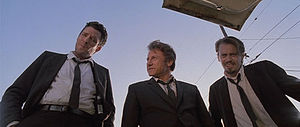
this is a low angle shot and creates the feeling that the audience is in the trunk of the car and those characters of the shot are looking to it. It makes the audience wonder what's inside the trunk.
(In Reservoir Dogs: Mr Brown, Mr pink and Mr White looking at Marvin Nash)
Corpse POV:

as the trunk shot, is a low angle shot in which creates the feeling of loss of power.
(In Jackie Brown: Jackie and Ray looking at Ordell dead)
"God eye" POV:

it's an extreme high angle shot which shows more than what the character can see, it creates the sense of control as the audience can see everything clearer.
(In Jackie Brown: Jackie Brown hides money in her bag at the airport's toilets)
6. Mirror shot:

(In Kill Bill: the Bride in the bathroom looking at her stomach)
It's a shot in which the character has intimacy and privacy in which it thinks and talks to himself.
7. a) Mexican standoff is a shot in which two or more characters are staring at each other with guns.
b) The term comes from "The Good, the Bad and the Ugly", a Sergio Leone's film from 1966.
c) The Good, the Bad and the Ugly:

Three Kings:

d) Reservoir Dogs:

Pulp Fiction:

8. a) MacGuffin is a plot element that catches audience atention. The main characters want to do or obtaing something and can sacrifice everything to get it, like money for example. This pushes foward the plot. It's a common element in the thriller films.
b) The MacGuffin in Pulp Fiction is the suitcase.
c) Mission Impossible 3:

Star Wars:

lunes, 4 de julio de 2011
Production Journal
In my group we are three girls: Sabrina, Viveka and me, Giuliana. The first thing we did before planning our work was divide the rols: Sabrina is the editor and writer (as the has very good ideas for the script or plot of the documentary and she is very good with the computer, for editing), Viveka the researcher and talent (because she likes to talk with the people we are going to work with and search about where can what place can we go, for example) and me the camerawoman and producer (as I'm very talent with cameras). Then we decided what was going to be our documental about. First we thought about doing it about "Filochicos", that is an organization that helps the poor children of Quilmes, but we realized that it was going to be very complicated because we had to talk with each parents of the childrens. So we decided to change our theme. After discussing a long time, we finally decided of doing it about "Tattoos" because we thought it was a very interesting theme that would like to the young audience as it is tattoos are a way for people to express their thoughts and feelings in a very different and crazy way.
After deciding what the documentary was going to be about, be made our storyboard with illustrations of how we imagine our shots are going to be and detailled descriptions of that shots (including angle-shot, light, sound, characters, setting, editing, etc.).
After deciding what the documentary was going to be about, be made our storyboard with illustrations of how we imagine our shots are going to be and detailled descriptions of that shots (including angle-shot, light, sound, characters, setting, editing, etc.).
jueves, 30 de junio de 2011
Notes of Capturing the Friedmans (Jarecki, 2003)
Pre-production activities
![]()
- Contact people involved in Arnold's life and the ones that could offer us all the necessary information (like de lawyer, the police officers, friends, neighbours, etc.) and interview them.
- Decide where do we want to film (setting).
- Get all the home movies of the Friedmans.
- Organize our work (in what part of the film include the old photographs, the home movies, the interviews, videos of the court or the different shots and images, etc.)
- Find a place for filming in which the person who we are interviewing is related.
- Research information of the case and the different points of view of the persons.
- Ask for permission of the court and the family for doing this movie.
- The people filmed were all the members of the Friedman's family, the lawyer, the policeman and everyone that could be involved in the case.
- The setting in which the people was interviewed was in places that characterized them (like the office of the lawyer, the living room of the house for the mom, the bedroom for one of the sons, etc.).
- Also used home movies and photographs of the family, videos of the court, images from the police and included in the film with jump cuts.
- The editor added scaned photographs as the interviewer was speaking, making the audience feel the atmosphere that this creates and for understanding better what was really happening in the house. In this way the voice is different to the shot.
- All the images and videos included are added in the exact moment of the interviews so it has a better relation, like when the person is telling something that appears in an image, there the editor includes it.
- It has no sound, only in some parts a background music that helps the audience to enter to the mind of the person speaking and all the problems that they are facing.
- Film makers didn't want to use a narrator/talent or voice-over because all the movie it's made up by the interviews, so if they would included a voice-over it would lost the appearance of "reality" that the movie has by letting the persons speak by their own without someone asking them anything.
- Not everything the news tell you it's exactly like that.
- What do the family felt and what problems they had to face when everyone was thinking only about the crime done by Arnold and prejudged him and his family.
- Creat doubts in the audience and confuse them about if it's true or not that they are guilty and in the end of the film we still don't knowing the truth.

lunes, 13 de junio de 2011


miércoles, 8 de junio de 2011
Eden Lake – Textual Analysis
Eden Lake – Textual Analysis
Eden Lake is a James Watkins horror film; it is publish in 2008 and make in United Kingdom. This film it’s about a couple who go to Eden Lake to expend a romantic weekend break in which Steve, the boyfriend, wants to propose her marriage but unexpected violent situation with children happen and make this impossible.
In the first five minutes of the film the plot gives us lots of important factors that help us to learn and understand what the movie it’s about. One of this is, in the beginning of the film, there are some little kids in the school and Jenny is the carrying teacher of them. This scene creates a feeling of family, happiness and innocence because kids are completely helpless and depend on adults or other responsible people. Another factor is the love story between Jenny and Steve shown in their dialogue, kisses and the ring that has Steve that means that he is completely committed with her. When Steve goes to look for Jenny we can see that they are going on a trip because of the shot in the GPS and the different jump shots that in each one the sky gets darker, what represents that is a long journey. When they arrive, some boys cross with their bikes and then a man don’t let Steve park and creates a different atmosphere, and we can deduce that it’s a bad start on the vacation.
Regarding to the characters, Jenny seems to be a patient and sweetie girl who likes kids and is in love; she smiles frequently, dresses with a purple and white feminine summer dress and walks and talks pacifically. We can see the balance of harmony through the low position of the camera at the start with the children and teacher and the close ups of happy children and the happy facial expressions of woman in her job. Steve, her boyfriend, is also in love and kisses her regularly; he is romantic because he prepared a weekend journey for proposing her marriage, what means that he is faithful and committed, he is funny, makes jokes all the time and makes her laugh but he is very inpatient as when the guys cross the semaphore and their parents stole his park space he gets very mad. He wears a blue shirt and makes the sense that he is a working man, tidy, organized and professional. We can realize the balance that they both have (Steve and Jenny) in their relationship because there is a two-shot from the back of the car showing them meeting in the middle and kissing in symmetry. Their happiness is represented with the clear and bright colors used and the natural sunlight. The objects that they have represent their social status, for example the car (Jeep), sunglasses (Ray Bans), the luxurious ring, the gadget in the car seen in the middle of back seat with middle shot. In contrast, the guys are very disrespectful, ride bikes, and are reckless, ignorant, blurred, indistinct, they cross the road laughing without carrying about the others. And their parents are irresponsible and freckles as they let their children be outside the house at night and without any control and are disrespectful because when Steve was going to park, they take his place.
We can say that Eden Lake is a horror film because of the style that the movie has. The cinematographer makes close-up shots in faces, interior shots of the car to start, exterior shots into the car when they arrived and creates shadows in each thing and person, has a suspense music background most of the time (when they are driving, the high pitched violin increase the tension), it has happy and innocents characters, the director makes emphasis in the radio that talks about the behavior of teenagers and the irresponsibility of their parents, as the setting gets darker more minor chords and melancholy sound are used, the camera first shows the point of view of Steve and Jenny but when the situation transforms in uncomfortable the camera turns facing them, the attitudes of the characters makes the audience feel the same as them (sadness, happiness, madness, etc.), from the busy highway we see an isolated junction which the characters go down.
In the film we can see the differences between middle class people and working class people. The ones from middle classes live in the city, receive education, go to school, have technology stuff, the characters in the film are happy and respectful and the director highlights these differences with the use of the contrast between the daylight or summer and the other way round for the “have-nots”, also by their actions, their physical aspects, their clothe, how they treat others, etc. The working class people live in country, village or small town, children are on the streets at night, what implies that their parents are not looking after them, the first appearance of the adults is in pubs drinking, and their zone is darker and gives us a cold atmosphere. The cinematographer shows the separation between the characters that are from one world to the other, line in the car scene. We can see the youth and violence when the radio plays news showing the dealing with bad behavior of children and parents put the blame of this on the education system, schools blame the parents. There is an implicit criticism of education through the journey taken by the girl, who represents the world of education although she ends up killing the kids.
In conclusion, the first five minutes of the film gives a very extended look of the whole movie and lots of clues that let us guess what the film is about, what themes are involved and what is going to happen. It has lots of effects and good actors that transmit to us what they feel and think and also, as all horror films, we get scared in the most suspense parts.
lunes, 30 de mayo de 2011
Eden Lake, jump cut analysis
In the opening of Eden Lake we can se that, after the boyfriend looks up to his girlfriend, the cupple are travelling to somewhere. When they are in the road or highway the camera shows the journey in the point of view of the man. The cuts have the same position of the camera and the same background music but it shows the change in lighting of the day, the passing of the hours, the different cars driving along. This effect creates the meaning of the hours passing through and the suspense of where are they going.
A Bout of Souffle – Jump cut
The clip of A Bout de Souffle (Godard, 1960) has unussual jump cut in which it shows the time passing by filming the same shot with a different background, as they are riding a car, and the girl carring other objects like a mirror, but the camera stills in the same position and the music it's also the same.
Suscribirse a:
Entradas (Atom)